Estimate
Filtered latent Heston variance from daily returns with an Unscented Kalman Filter.
 THEO VERDELHAN - PortfolioLIVE MARKET INTERFACE
 BTC/USDT—
LATENCY—
CASE 04 · VOLATILITY RESEARCH
Heston–UKF filtering · Implied-realized spreads · Dynamic short-strangle allocation
SPY and AAPL option chains.
Static, Heston–UKF and RV_21d timing.
Rolling window with a 10-day refit schedule.
Clipped short-volatility allocation.
RESEARCH QUESTION
The option trade remains a short one-week strangle. Only its exposure changes with the spread between market-implied volatility and estimated realized volatility.
Filtered latent Heston variance from daily returns with an Unscented Kalman Filter.
Measured implied volatility against UKF and 21-day realized-volatility estimates.
Smoothed and standardized each spread into a clipped 0×–2× allocation.
Applied the allocation to the same short one-week strangle strategy.
Compared total return, Sharpe, Calmar and drawdown on SPY and AAPL.
EMPIRICAL EVIDENCE
Both timing signals improved total return over static carry, while the simpler RV_21d rule remained the strongest specification in these samples.
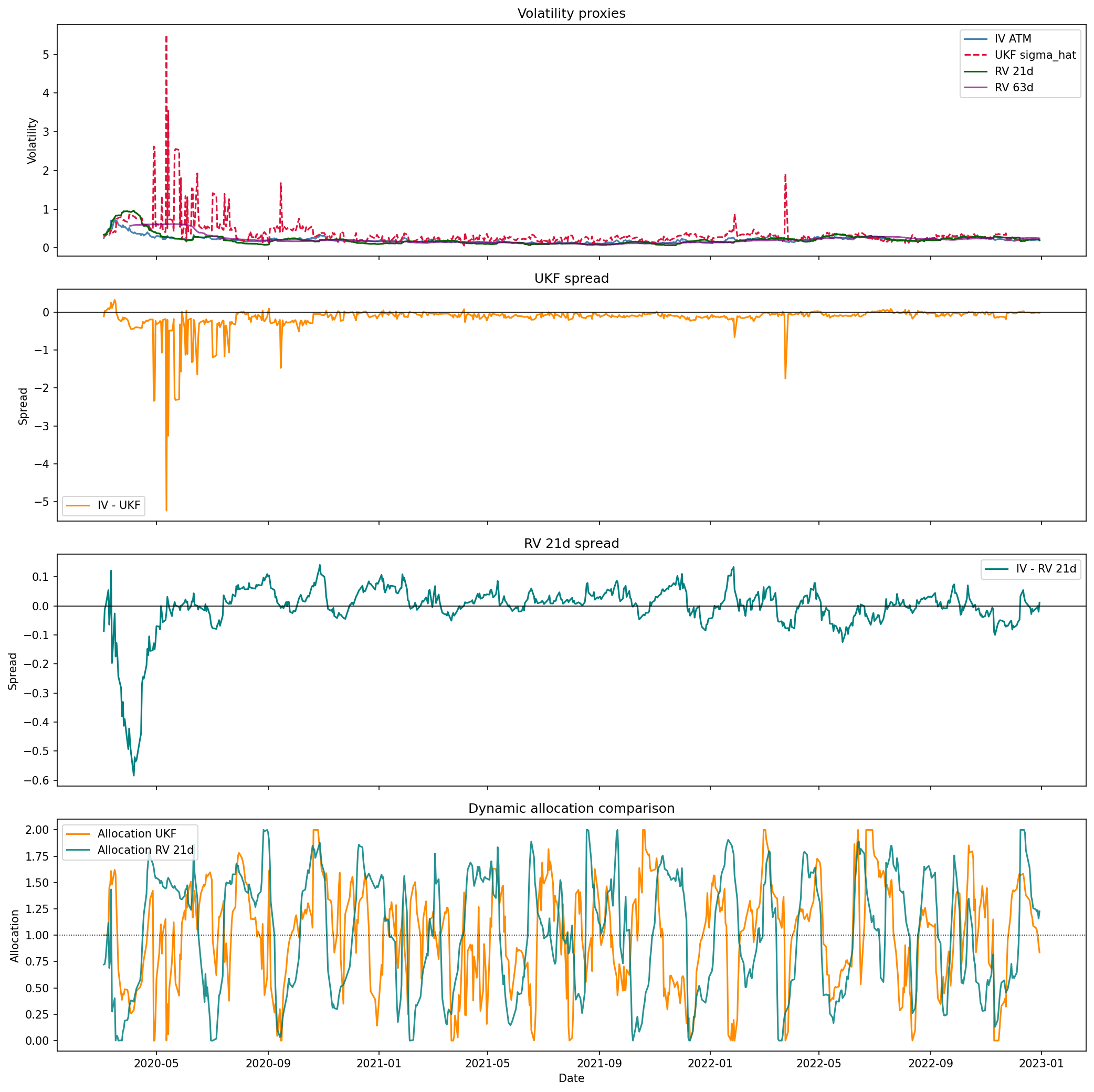
The UKF and RV_21d spreads produce distinct allocation paths under the same 0×–2× exposure constraints.
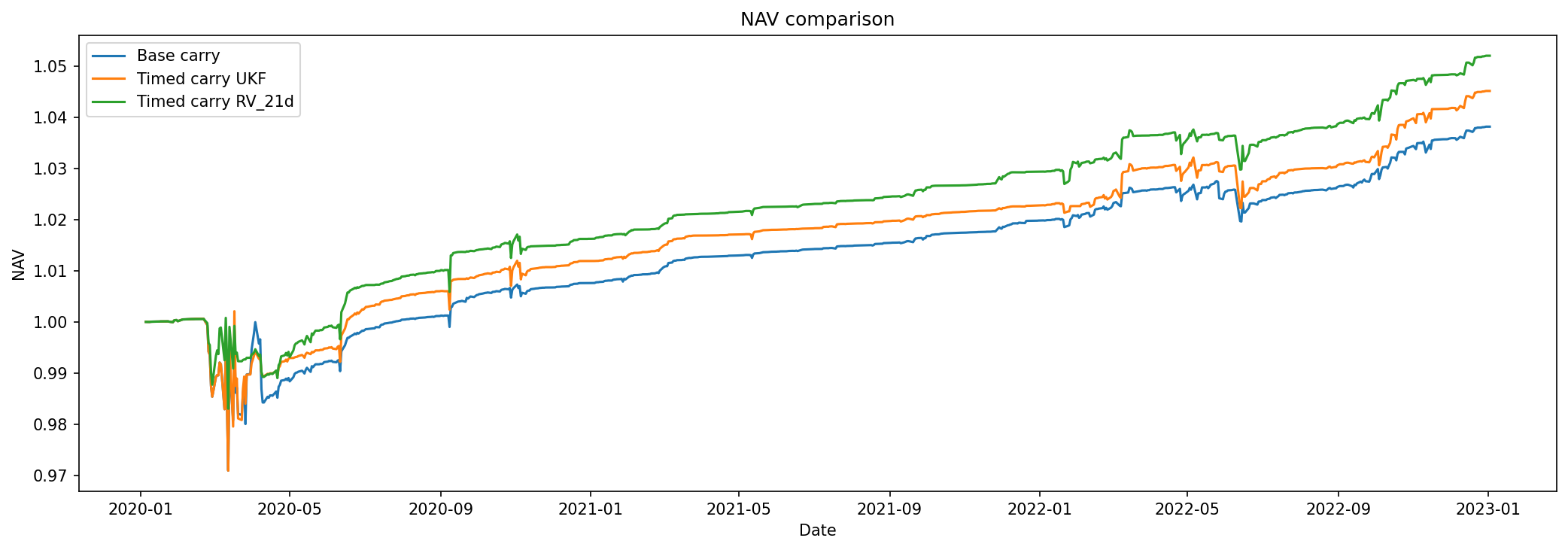
UKF timing improved total return, but the simpler RV_21d signal delivered the highest Sharpe at 0.855 and the lowest drawdown at 1.77%.
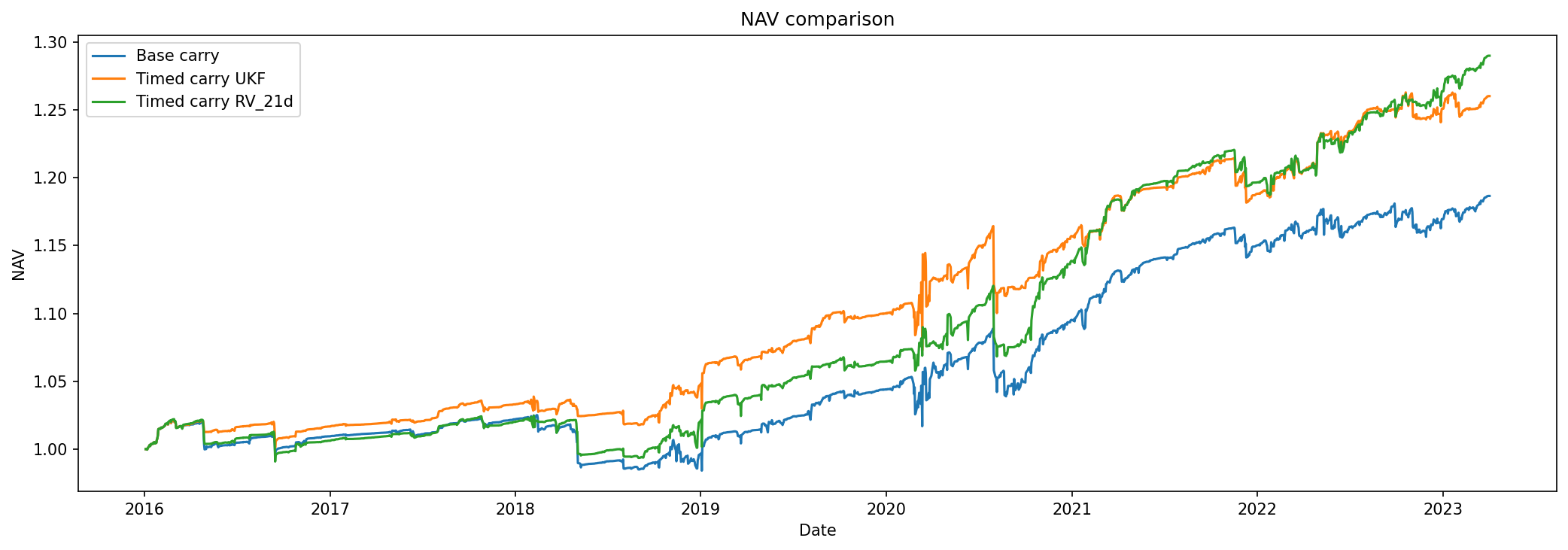
Both timing rules improved the static strategy over the 2016–2023 sample; RV_21d again ranked first.
CORE FINDING
The Heston–UKF signal was directionally useful on both assets, yet a transparent 21-day realized-volatility benchmark produced stronger risk-adjusted results.
LIMIT
Production use would require explicit transaction costs, margin, option-surface liquidity, leg execution and stability tests beyond two underlyings.